Dahua vs Hikvision Cameras: Which Fits Your Site?
A surveillance project can look straightforward until the first camera is installed. Then the real questions arrive: Will faces be usable at the gate after dark? Can the recorder support the required retention period? Will the cameras work with the existing VMS? In the Dahua vs Hikvision cameras decision, the best choice is rarely determined by brand name alone. It comes down to the site, the operating workflow, the selected product series, and procurement requirements.
Both manufacturers offer extensive IP camera, NVR, PTZ, thermal, and access-control portfolios. Both can support small business installations and large multi-site deployments. The practical difference is not that one brand always wins. It is how well a specific camera and platform combination meets the operational need without adding avoidable cost or management complexity.
Dahua vs Hikvision Cameras: Start With the Site Requirement
Do not begin by comparing megapixel numbers. Begin with the scene. A fixed camera watching a well-lit office entrance has very different requirements from a camera monitoring a loading yard, parking area, warehouse aisle, or perimeter fence.
For identification, the installer must account for camera height, lens angle, subject distance, lighting direction, and expected movement. A high-resolution camera mounted too high or aimed across a wide area may produce an impressive overview but poor facial detail. In many business deployments, correct lens selection matters more than moving from 4 MP to 8 MP.
Hikvision has a broad range of cameras across value, professional, and specialized categories. Its AcuSense line is commonly selected for perimeter and entry-point monitoring because it can distinguish people and vehicles from many routine motion events. ColorVu models are designed for stronger color imaging in low-light scenes, subject to the available ambient light and the model’s specifications.
Dahua offers comparable coverage through its entry-level, WizSense, and WizMind families. WizSense models are often positioned for AI-assisted detection at a practical price point, while WizMind products target more advanced analytics and professional deployment needs. Dahua’s TiOC range combines active deterrence features such as light and sound warnings with AI-based event filtering on supported models.
The names are useful shortcuts, not technical guarantees. Product capabilities differ by generation, firmware, region, and hardware revision. Confirm the exact model data sheet before committing a camera to a design.
Image Quality Is More Than Resolution
A camera should be judged by usable evidence, not by its maximum specification. Resolution helps when the lens, sensor, scene illumination, bitrate, and recording settings are appropriate. It does not fix motion blur, headlight glare, backlit doors, or a poorly placed camera.
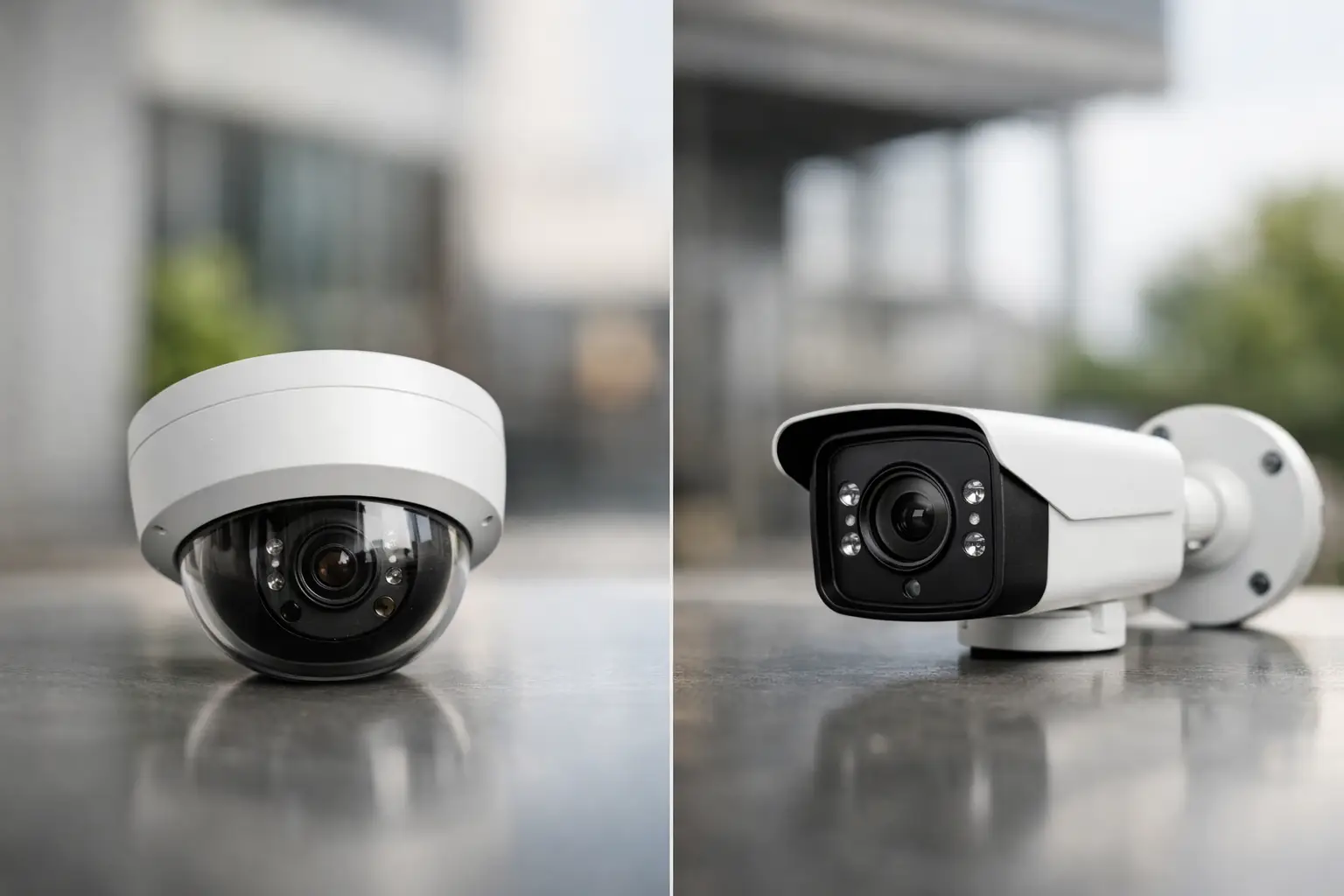
For indoor offices, retail areas, and corridors, both brands offer compact turret and dome cameras with practical IR illumination, wide dynamic range, and integrated microphones on selected models. Turret cameras are frequently easier to aim and maintain than dome cameras, especially where IR reflection can become an issue. Domes may be preferred where appearance, vandal resistance, or tamper protection is the priority.
For outdoor locations, compare the effective night performance rather than simply checking whether a camera has infrared. IR can provide clear monochrome video in darkness, but color low-light models may offer more useful contextual detail when ambient lighting is available. Vehicle color, clothing color, signage, and packaging may matter to an investigation. At the same time, color imaging can require supplementary lighting when the site becomes fully dark.
Hikvision and Dahua both provide varifocal cameras for scenes where the final field of view needs adjustment during installation. This is often a sound choice for gates, cash points, warehouse entrances, and vehicle lanes. A fixed-lens model can reduce hardware cost, but only when the coverage distance is already well understood.
AI Analytics: Reduce Noise Before Adding More Cameras
The strongest operational argument for AI analytics is not novelty. It is reducing false alerts. Rain, shadows, insects, trees, and passing animals can make ordinary motion detection impractical at exterior sites. Human and vehicle classification helps security teams focus on events that require review.
Hikvision AcuSense and Dahua WizSense each address this need on many compatible devices. Either can be a good fit for a branch office, warehouse, or commercial property where operators need filtered alerts from a limited number of cameras. Advanced product lines from both vendors can add functions such as intrusion rules, people counting, queue monitoring, ANPR or LPR, and behavior analysis.
Analytics should be matched to a process. If no one is assigned to investigate alerts after business hours, advanced detection may not deliver its full value. If a logistics yard needs evidence of unauthorized vehicle entry, a properly designed vehicle rule, appropriate camera angle, and notification path can be more valuable than installing several general-purpose cameras.
Also evaluate where analytics run. Edge-based analytics on the camera can reduce dependence on recorder processing capacity, while NVR-based analytics can simplify camera selection in certain designs. The supported number of AI channels, event types, and search functions should be verified at the recorder level, not assumed from the camera description.
Software, Recorders, and Daily Administration
A camera system is a working platform, not a collection of devices. For small installations, the mobile and desktop client experience may be sufficient. For a multi-site organization, the central management software, user roles, health monitoring, audit requirements, and integration options become more significant.
Hikvision systems commonly use Hik-Connect for remote end-user access and HikCentral for broader centralized management. Dahua systems commonly use DMSS for remote access and DSS Pro for larger or more integrated deployments. Both ecosystems can support live view, playback, event review, user permissions, and selected integration scenarios.
The right question is whether the software supports the way the organization operates. A facilities manager may need easy remote viewing across a few locations. A security team may need a control-room interface, camera status monitoring, mapped views, incident export, and role-based access. A systems integrator may need documented compatibility with an existing access-control, intrusion, or building-management environment.
Native camera and NVR combinations can make deployment simpler and may expose more analytics features. ONVIF support can help when a project includes mixed brands or a third-party VMS, but it does not ensure that every advanced feature transfers between platforms. Test the required functions – video stream, audio, events, PTZ control, recording, and analytics metadata – before standardizing on a mixed environment.
Cybersecurity and Compliance Need a Procurement Review
Network cameras are connected devices and should be treated accordingly. The camera brand does not replace sound network design. Segment surveillance equipment on an appropriate VLAN, use unique strong credentials, disable unused services, restrict remote administration, and maintain a documented firmware process. Avoid exposing cameras or NVRs directly to the public internet when a controlled remote-access method is available.
For both Dahua and Hikvision, buy through established supply channels and confirm model authenticity, regional firmware suitability, warranty terms, and update availability. Unverified devices can create support problems, firmware mismatches, and uncertainty about product origin.
Compliance can be decisive for government, education, critical infrastructure, and organizations operating under customer or contractual security requirements. Some projects may have restrictions related to NDAA Section 889, internal vendor policy, local regulations, or insurance requirements. These conditions are project-specific. Procurement teams should validate eligibility before a bill of materials is approved, rather than discovering a restriction after equipment reaches the site.
Retention is another overlooked requirement. A camera’s bitrate, resolution, scene activity, codec, recording schedule, and number of days retained determine storage demand. Estimate storage using realistic recording settings, then allow capacity for growth. Selecting an NVR only by channel count can leave a project short on PoE budget, drive bays, incoming bandwidth, or AI processing resources.
Which Brand Should You Choose?
Choose Hikvision when the selected Hikvision model, recorder, and management environment meet the required coverage, analytics, compliance, and support criteria at the right project cost. It is a practical option for organizations that want a wide selection of camera types and a familiar platform for distributed surveillance deployments.
Choose Dahua when a Dahua solution delivers the required image performance, AI functions, recorder capacity, and integration path more effectively for the design. Its broad catalog makes it relevant for projects ranging from standard IP surveillance to active deterrence, thermal monitoring, and larger professional systems.
For many buyers, the deciding factor will be neither logo nor headline specification. It will be availability of the exact models, compatibility with the chosen recorder or VMS, authorized supply, and the ability to replace or expand equipment later with matching hardware. Standardizing on one ecosystem can reduce training, configuration time, spare-stock complexity, and support overhead.
Before placing an order, build the bill of materials around each camera location. Specify the camera model, lens, mounting hardware, PoE requirement, NVR, storage drives, cable infrastructure, display needs, licensing if applicable, and power protection. This prevents a common purchasing failure: buying cameras first and discovering later that the system lacks storage, switching capacity, or the correct mounts.
A good surveillance purchase is one that produces useful evidence, manageable alerts, and predictable support after installation. GreenCode Tech can help business buyers source camera, recording, network, and accessory requirements as one coordinated procurement package, so the system arriving on site is closer to the system that was actually designed.